
Post-Acne Hyperpigmentation: Causes, Prevention, and Treatment Options in Singapore
Updated: Sep 24

Dark, flat marks that linger for weeks or months after a pimple has healed are one of the most common reasons people search for skin advice after a breakout. This is usually post-acne hyperpigmentation, also known as post-inflammatory hyperpigmentation (PIH). This guide explains what PIH is, how it differs from acne scars and post-inflammatory erythema (PIE), and the at-home and in-clinic approaches that are commonly discussed for managing it — including a note on ingredients that are prescription-only in Singapore.
Key points covered in this article:
PIH is a flat pigment change, not a scar — it does not involve permanent structural damage to the skin
Darker skin tones tend to develop more visible PIH that can take longer to fade
Consistent sun protection and avoiding pimple-picking are two of the most evidence-supported prevention steps
Topical retinoids, hydroxy acids, and broad-spectrum sunscreen currently have the strongest published evidence among at-home options
In-clinic options such as chemical peels, lasers, and microneedling may be considered by a doctor when topical care alone is insufficient
Hydroquinone and oral tranexamic acid are prescription-only in Singapore and are not permitted in over-the-counter cosmetic products
Understanding Post-Acne Hyperpigmentation
After an inflamed pimple heals, it can leave behind a visible mark on the skin. One of the most common marks is post-acne hyperpigmentation. Understanding what this is, why it forms, and how it differs from other post-breakout skin changes is a useful first step before considering how to manage it.
What Is Post-Inflammatory Hyperpigmentation (PIH)?
Post-inflammatory hyperpigmentation, often abbreviated as PIH, is the clinical term for flat areas of discolouration that can appear after an inflammatory skin condition — such as an acne lesion — has healed. These spots may range from light brown to dark brown or greyish tones, depending on an individual's skin tone and how deep the pigment sits within the skin. Unlike acne scars, PIH does not involve a structural change to the skin's texture, though the discolouration itself can take a long time to resolve.
PIH develops because inflammation stimulates melanocytes, the cells responsible for producing melanin. In response to injury or inflammation, these cells can produce excess pigment, some of which becomes deposited within the skin. This deposited pigment can remain visible well after the original acne lesion has resolved. PIH can affect people of every skin tone, but it tends to be more visually noticeable — and typically takes longer to fade — in individuals with medium to darker skin tones. A 2024 systematic review focused specifically on skin of colour patients found that most cases of PIH were triggered by inflammatory skin conditions and were most commonly located on the face, underlining how closely PIH is tied to acne in these skin types.
The Science Behind Dark Spots After Acne
Post-acne marks form as part of the skin's natural healing response. When an inflammatory acne lesion develops — such as a pustule, papule, or cyst — the body activates an immune and repair response in the affected area. This process can stimulate melanocytes to ramp up melanin production. In some cases, that excess pigment becomes distributed within the upper layers of the skin, and as the lesion heals, the pigment can remain visible as a flat, dark mark on the surface.
These marks can fade gradually on their own, but several factors influence how long that takes, including ongoing sun exposure, repeated inflammation (such as picking or further breakouts in the same area), and the individual's baseline skin tone.
PIH vs PIE vs Acne Scars: How to Tell the Difference
Several types of marks can appear once an acne lesion has healed, and identifying which one you have matters because the management approach can differ. The three most commonly discussed categories are compared below.
Post-Inflammatory Hyperpigmentation (PIH) | Post-Inflammatory Erythema (PIE) | Acne Scars | |
Appearance | Flat brown, tan, or greyish spots | Flat pink, red, or purplish marks | Depressed or raised areas with altered texture |
Underlying cause | Excess melanin production following inflammation | Vascular changes — dilated or damaged blood vessels | Structural change in skin tissue during healing |
Texture | Smooth; no change to skin texture | Smooth; no change to skin texture | Altered texture |
Blanching test | Pigmentation generally remains visible under pressure | Redness may temporarily fade as blood is displaced | Not applicable |
Common forms of acne scarring include atrophic scars (such as ice-pick, boxcar, or rolling scars), which form when tissue is lost during healing, and hypertrophic or keloid scars, which develop when excess collagen is produced during the repair process.
A trained clinician can sometimes help distinguish PIH from PIE using a blanching test, where gentle pressure applied to the skin temporarily displaces blood and causes vascular redness to fade, while melanin-based pigmentation generally remains unchanged. Because PIH and PIE can occur together — and because acne scars involve structural change rather than pigment or vascular change — a clinical assessment is useful for working out which condition, or combination of conditions, is actually present before deciding on a management approach.
At-Home Approaches for Post-Acne Hyperpigmentation

Improving the appearance of post-acne dark spots at home generally requires patience and a consistent routine, since PIH tends to fade gradually rather than disappear quickly. Over-the-counter products may help with mild to moderate discolouration, and consistent daily sun protection is important throughout, since ultraviolet exposure can stimulate additional melanin production and may slow visible improvement.
Building a Skincare Routine for Hyperpigmentation
A consistent routine that combines a treatment ingredient with barrier support and daily sun protection tends to work better than relying on any single product. When introducing any new active ingredient, it is generally advisable to start slowly — for example, every second or third night — and monitor how the skin responds before increasing frequency.
Morning routine
Gentle cleanser — removes overnight buildup without over-stripping the skin.
Vitamin C serum — provides antioxidant support and may help with uneven pigmentation over time.
Moisturiser — maintains hydration and supports the skin barrier.
Broad-spectrum sunscreen (SPF 30 or higher) — apply daily, including on cloudy days, since UV exposure can affect existing pigmentation regardless of visible sunshine.
Evening routine
Cleanser — removes sunscreen, makeup, and the day's buildup; some people prefer a double-cleanse.
Treatment product — active ingredients are usually applied at night. To reduce irritation, many people alternate between actives (for example, a retinoid on some nights and an exfoliating acid on others) rather than layering everything at once.
Moisturiser — supports overnight recovery, which is particularly useful when using active ingredients that can be drying.
New actives are best introduced one at a time, ideally with a patch test first, so that any irritation can be traced back to a specific product.
Ingredients Commonly Discussed for Post-Acne Hyperpigmentation
A 2022 systematic review of topical treatments for PIH, published in the Journal of Dermatological Treatment, found that retinoids, hydroxy acids, and broad-spectrum sunscreen were supported by the greatest number of high-quality studies, while niacinamide and certain plant-derived ingredients also had supporting evidence.
Retinoids (e.g. retinol, retinaldehyde) support skin cell turnover, which may gradually reduce the visible appearance of pigmentation as older, pigmented cells are replaced. Non-prescription forms are generally milder than prescription-strength retinoids such as tretinoin, which is a prescription-only medicine in Singapore. Retinoids can cause dryness or irritation at first, so they're usually introduced gradually.
Vitamin C is an antioxidant thought to influence tyrosinase, an enzyme involved in melanin production, while also helping protect skin from UV-related oxidative stress. Formulation stability varies, so look for products packaged to protect against light and air exposure.
Niacinamide (vitamin B3) is thought to work differently from the ingredients above — rather than affecting pigment production, it may limit how pigment transfers from melanocytes to surface skin cells, while also supporting the skin barrier. It is generally well tolerated across skin types.
Exfoliating acids help remove accumulated, pigmented surface cells. Glycolic acid penetrates the outer skin layers relatively easily; lactic acid is milder and also supports hydration. Azelaic acid is frequently used in acne-prone or sensitive skin, as it's thought to act on pigment pathways while also having anti-inflammatory properties. Over-exfoliating can trigger the very inflammation that causes PIH, so consistency matters more than intensity.
Tranexamic acid has drawn growing interest in dermatology, though the evidence base specific to PIH is still smaller than for the ingredients above; oral tranexamic acid is a prescription medicine in Singapore.
Ingredient | General Role | Considerations |
Retinoids (e.g. retinol, retinaldehyde) | Supports skin cell turnover, which may gradually reduce the visible appearance of pigmentation | May cause irritation initially; best introduced gradually |
Vitamin C (e.g. L-ascorbic acid and derivatives) | Antioxidant; thought to influence tyrosinase activity involved in melanin production | Formulation stability varies between products |
Niacinamide (Vitamin B3) | May reduce the transfer of pigment from melanocytes to surface skin cells; supports the skin barrier | Generally well tolerated across skin types |
Alpha Hydroxy Acids (e.g. glycolic acid, lactic acid) | Chemical exfoliation that encourages removal of pigmented surface cells | Glycolic acid penetrates the outer skin layers more readily; lactic acid is generally milder |
Azelaic Acid | May influence pigment production pathways; also has anti-inflammatory properties | Often considered for sensitive or acne-prone skin |
Tranexamic Acid (topical) | Ingredient of growing interest for inflammation-related pigmentation | Evidence for PIH specifically is more limited; oral form is prescription-only in Singapore |
A Note on Prescription-Only Ingredients
Hydroquinone and oral tranexamic acid are prescription-only medicines in Singapore and are not permitted in over-the-counter cosmetic products. If either is something you're considering as part of managing PIH, it's worth discussing with a doctor, who can advise on suitability and supervise use.
Professional Treatment Options for Post-Acne Hyperpigmentation
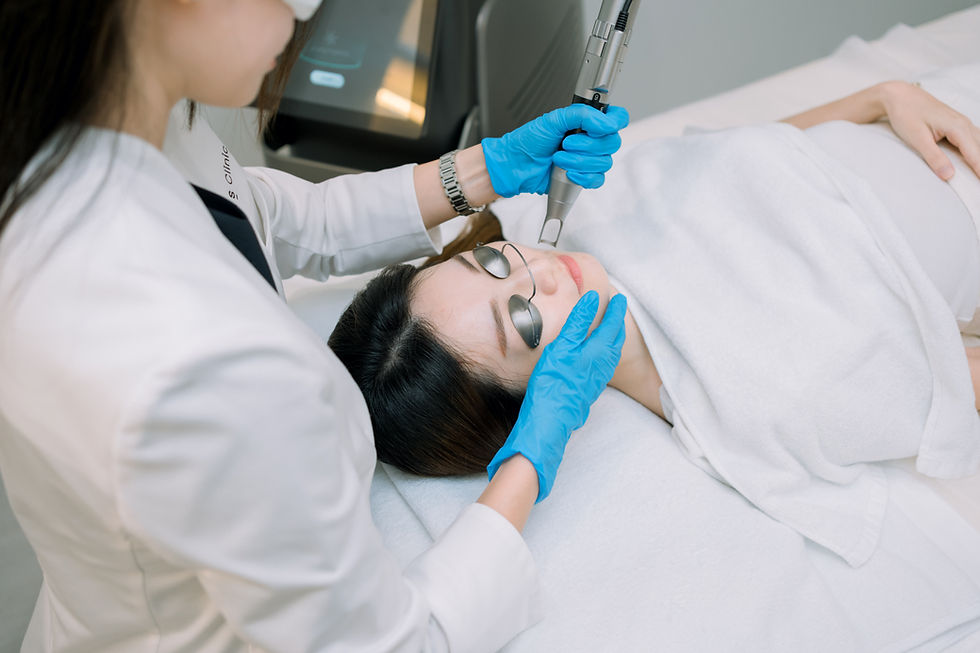
When over-the-counter skincare has not produced the desired improvement after a reasonable trial period, some people consider in-clinic procedures performed by a licensed doctor. These treatments work through different mechanisms, and a doctor will typically assess skin type, the depth and severity of pigmentation, and any history of keloid or scarring tendency before recommending a specific approach, since the "best" option genuinely depends on these individual factors rather than being the same for everyone.
Chemical Peels for Deeper Exfoliation
Chemical peels involve applying a chemical solution to the skin to create controlled exfoliation, removing layers of pigmented surface cells and encouraging renewal. Doctors select the depth of peel based on the individual's skin characteristics and the severity of pigmentation.
Superficial peels typically use milder acids such as glycolic, lactic, or salicylic acid, affect only the outermost skin layers, and usually involve minimal downtime, though several sessions may be needed. Medium-depth peels, which may use trichloroacetic acid (TCA), reach deeper into the skin and are sometimes considered for more pronounced pigmentation, but they also involve a longer recovery period. Because inappropriate peel selection can itself trigger new PIH, individuals with darker skin tones are generally assessed with additional care before a peel — particularly a deeper one — is recommended.
Laser and Light-Based Treatments
Laser and light-based devices deliver targeted energy into the skin. For pigment-based marks like PIH, this energy interacts with melanin in the pigmented area, and the body's natural clearance processes gradually remove the fragmented pigment afterward.
Intense pulsed light (IPL) devices emit broad-spectrum light that can target pigmented areas, but careful patient selection matters, since individuals with darker skin tones carry a higher risk of pigment-related side effects with IPL. Q-switched lasers deliver very short pulses of energy that can target concentrated areas of pigment; the exact wavelength and settings used are determined by a doctor based on skin tone and pigment depth. Fractional lasers treat microscopic zones of skin while leaving surrounding tissue intact, which supports skin remodelling and may improve both pigmentation and texture, typically over a series of sessions rather than a single treatment.
It's worth noting that laser treatment targets pigment (brown marks), while post-inflammatory erythema — the pink or red marks discussed earlier — generally responds better to vascular-targeting lasers, such as pulsed dye lasers (for example, Vbeam), which work on blood vessels rather than melanin. Because PIH and PIE can occur side by side after acne, a doctor's assessment helps determine whether one treatment, or a combination, is more appropriate.
A 2024 systematic review published in the Journal of Cutaneous Medicine and Surgery, focused on patients with skin of colour, found that among the treatments studied, topical retinoids and laser therapy were the most frequently used interventions, with partial improvement reported in 85% and 66% of cases respectively, and laser therapy being the only approach associated with complete resolution in a subset of patients (around a quarter). The same review also documented cases where laser treatment worsened pigmentation rather than improving it. These figures come from pooled data across many published studies and reflect group-level outcomes — they do not predict what any individual person will experience, which is one reason a pre-treatment assessment and, where appropriate, a test patch are commonly used before proceeding with laser treatment on darker skin tones.
Microneedling: Mainly for Texture, Not a Pigment-Targeting Treatment
Microneedling, sometimes called collagen induction therapy, uses a device with fine, sterile needles to create controlled micro-injuries that trigger the skin's natural repair processes. Unlike lasers, it does not use light or heat aimed at melanin — a review of microneedling in skin of colour, published in the Journal of the American Academy of Dermatology, notes that because it doesn't target specific pigment-absorbing wavelengths, it has only a minimal direct effect on pigmentation itself. Its best-documented benefits are for skin texture, scarring, and improving how well topical products penetrate afterward, with any change in PIH generally considered a secondary, adjunctive effect rather than the main reason it would be chosen.
Precisely because it doesn't target melanin directly, microneedling is often considered to have a comparatively favourable safety profile for darker skin tones that are more prone to PIH from other procedures. That said, as with any treatment that creates controlled injury to the skin, there is still some risk of new pigmentary changes, and this should be discussed with a doctor beforehand; multiple sessions are typically required as part of an individualised plan.
Comparing In-Clinic Treatment Options
Treatment | Primary Mechanism | Key Considerations |
Chemical Peels | Controlled exfoliation to encourage renewal | Superficial to medium depth; downtime varies; darker skin needs careful peel selection |
Intense Pulsed Light (IPL) | Broad-spectrum light targeting pigment | Higher risk of pigment side effects in darker skin tones |
Q-Switched Laser | Short energy pulses targeting concentrated pigment | Settings individualised by skin tone and pigment depth |
Fractional Laser | Micro-treatment zones with intact surrounding tissue | May improve both pigmentation and texture over a series of sessions |
Microneedling | Controlled micro-injury to stimulate repair | Does not directly target melanin; best evidence is for texture/scarring, with pigmentation benefit as a secondary effect |
Pulsed Dye Laser (e.g. Vbeam) | Targets blood vessels, not melanin | Used for post-inflammatory erythema (redness) rather than PIH itself |
How to Prevent Post-Acne Hyperpigmentation
Existing dark spots can gradually improve with the right care, but preventing new marks from forming in the first place is just as important for long-term skin tone. Prevention generally comes down to reducing inflammation and protecting the skin from the factors known to worsen pigmentation.
Sun Protection
Daily broad-spectrum sunscreen (SPF 30 or higher) is one of the most consistently supported recommendations across the published literature on PIH, since UV exposure can stimulate additional melanin production and darken existing spots. Reapplication is worth considering during extended outdoor exposure, including on cloudy days, since UV radiation still reaches the skin through cloud cover.
Avoiding Pimple Picking
Picking, squeezing, or popping acne lesions increases inflammation and trauma in the surrounding skin, which stimulates melanocytes to produce more pigment during healing. Letting lesions heal naturally, or managing them with appropriate skincare rather than manual extraction, reduces this additional trigger for PIH.
Managing Active Acne
Fewer active breakouts generally means fewer opportunities for the inflammation that leads to pigment changes. A routine built around ingredients such as salicylic acid, benzoyl peroxide, or retinoids can help keep active acne under control; if over-the-counter options aren't providing enough improvement, a doctor can help determine whether prescription treatment is appropriate for the underlying acne itself.
How Long Does Post-Acne Hyperpigmentation Take to Fade?
There is no single timeline for PIH — it depends on several interacting factors, summarised below.
Factor | How It May Affect PIH Duration |
Severity of inflammation | Deeper lesions (cysts, nodules) tend to trigger a stronger pigment response and take longer to fade than superficial pimples |
Skin tone | Darker skin tones tend to show more visible pigment change that can take longer to resolve |
Sun exposure | Repeated UV exposure can re-darken existing spots and slow overall improvement |
Skincare consistency | A steady routine with renewal-supporting ingredients tends to support more consistent progress than sporadic use |
Mild marks may fade within a few months, while deeper pigmentation can persist for a year or more without intervention. In-clinic procedures such as chemical peels or laser treatment are typically considered once topical skincare alone hasn't produced enough improvement after consistent use — with the understanding, based on the research discussed above, that responses vary and that more than one session is usually needed.
Frequently Asked Questions
Does post-acne hyperpigmentation go away on its own?
In many cases, mild PIH fades gradually on its own over several months as the skin's natural renewal process replaces pigmented cells. Deeper or longer-standing pigmentation may persist for longer and may benefit from a combination of consistent sun protection, topical actives, and — if needed — an in-clinic assessment.
What is the difference between PIH and an acne scar?
PIH is a flat change in skin colour with no change to skin texture, caused by excess melanin. An acne scar involves an actual structural change to the skin — either tissue loss (atrophic scarring) or excess tissue (hypertrophic or keloid scarring) — and generally requires a different management approach than pigmentation alone.
Is hydroquinone available over the counter in Singapore?
No. Hydroquinone is a prescription-only medicine in Singapore, and it is not permitted in over-the-counter cosmetic skincare products under HSA regulations. It should only be used under a doctor's supervision.
Which is more effective for PIH: chemical peels or laser treatment?
There is no single "better" option — the two work through different mechanisms, and a doctor typically chooses based on skin tone, pigment depth, and how the skin has responded to previous treatments. Published research suggests laser therapy can achieve complete resolution in some patients but also carries a documented risk of worsening pigmentation in others, which is why an individualised assessment matters more than choosing based on treatment type alone.
Can sunscreen alone treat existing dark spots?
Sunscreen does not remove existing pigmentation, but it is considered an essential part of any PIH management plan, since ongoing UV exposure can re-stimulate melanin production and undo progress made with other treatments. Most published research on PIH treatment includes daily broad-spectrum sunscreen as a baseline recommendation alongside other therapies.
When to See a Doctor

If post-acne dark spots are not improving after several months of consistent skincare and sun protection, or if you are dealing with both active acne and existing pigmentation, a consultation with a doctor can help clarify whether what you're seeing is PIH, PIE, early scarring, or a combination — and which combination of at-home and in-clinic options may be worth considering for your specific skin.
Conclusion
Post-acne hyperpigmentation is a common — and usually temporary — consequence of inflammatory acne, though it can take considerable time to resolve, particularly in medium to darker skin tones. At-home routines built around retinoids, vitamin C, niacinamide, and exfoliating acids have reasonable published support, and consistent broad-spectrum sun protection is one of the most evidence-backed steps in preventing new marks from darkening further. When topical care alone isn't enough, in-clinic options such as chemical peels, laser treatment, and — in a more adjunctive role — microneedling can be considered following an assessment by a doctor. Ingredients such as hydroquinone and oral tranexamic acid are prescription-only in Singapore and should only be used under medical supervision, not through unregulated over-the-counter products.
Please see below for treatment details.
Note: This article is for educational purposes only and does not constitute medical advice. Individual treatment plans should be developed in consultation with qualified healthcare professionals. Treatment outcomes vary from person to person, and no guarantee of results is intended or implied. All professional treatments mentioned should be performed by licensed medical practitioners in Singapore, using HSA-approved products, devices, and techniques, as applicable.


